
Japanese language school in Tokyo, Japan
Search Results for: en
- 13
12月 18
-
- 11
12月 18
-
SCHOOL CALENDAR
Our normal school year is divided into four seasonal terms starting in January, April, July, and October.
Download the schedule here: 2025 Academic Calendar
- 11
12月 18
-
PAYMENT METHODS
As much as possible we try to keep our tuition and fees low so that students can afford to study longer and thus get more out of their studies. Students can select the payment method.
International payments – Flywire(recommend)
To submit payment from outside Japan
- Payment will be posted to your account within two to five business days.
- Flywire allows you to pay securely from any bank, generally in your home currency.
- When setting up your Flywire account, use the same e-mail that you used on your application form.
- For more detail, see flywire-pdf
When you make a payment through Flywire you can
- Track your payment from start to finish
- Save on bank fees and exchange rates
- Contact their multilingual customer support team with any questions, day or night. For more information, visit the Flywire help page.
How to make a payment
- At below, enter your country of origin, then click CONTINUE TO FLYWIRE. You will be redirected to Flywire website. Or, just go to yosida.flywire.com.
- Select payment method and create (or login to) your Flywire account, then enter some basic information to initiate your payment booking.
- Follow instructions to send payment funds to Flywire. For debit/credit card payments, enter your card details online to complete your payment in your home currency. (Additional local payment options may be available depending on the country you are paying from.)
- Track your payment any time by logging into your Flywire account. Receive text and email status updates each step of the way, including a confirmation when your payment has been delivered to your institution.
International payments – Bank
| Bank Account Information | |
| Ⅰ. School Name | YOSHIDA NIHONGO GAKUIN |
| Ⅱ. Bank | MUFG bank |
| Ⅲ. Branch | TAKATANOBABA |
| Ⅳ. Account | Regular account No. 2123243 |
| Ⅴ. SWIFT code | BOTKJPJT |
Payment instructions
- If paying in person : Bring your payment with a course-enrollment form to our office by the deadline.
- If paying application fee through PayPal : We will send you an invoice.
- 11
12月 18
-
Svenska Sökande
Ansökan om studentvisum
För att ansöka om långtidsstudier måste du förbereda dokumenten nedan och skicka dem till oss inom tidsfristen. Du kan hitta alla nödvändiga formulär och instruktioner för hur du fyller i dem.
En sökande måste vara de som har slutfört 12 års skolgång som erkänts som standard i Sverige, eller alternativt som har bedömts av lämplig fakultet som har en motsvarande skolastisk förmåga i sitt eget land.
Du kan också studera japanska medan du arbetar deltid på ett visum för arbetshelgen. Klicka Klicka på Working Holiday-schema för mer information. Klicka HÄR för att kontakta oss.
| Applicant (Application Requirements) / via emails | |
| Application form (MS word or PDF) |
Use the prescribed form. Form(PDF)|Form(MS word) |
| Personal Records (MS word or PDF) |
Use the prescribed form to list your (a) educational history, from elementary school through the last school attended and (b) the purpose of your study. Form(PDF)|Form(MS word) |
| Diploma or Transcript (PDF or JPG) |
The diploma (or transcript) from the last school you attended. It must be the scanned via email. Do not need to send the original. |
| Photographs (JPG) |
The person should face squarely to the front and remove hats, caps or head coverings. (a clear image and color photograph.) |
| Copy of passport (PDF or JPG) |
If you already have one. It must include all the pages which show applicant’s photo, passport number, and past visit (s) to Japan. |
| Supporter (CSN) | |
| Dokument från CSN krävs inte. | |
| Please send them as email attachments to Yoshida Institute. (pdf|word|zip|other) | |
A sample of a writing style
| A sample of a writing style(long-term) | ||
| Application Requirements | MS word | |
| 1.Application form | sample(81 kb) | sample(16 kb) |
| 2.Personal Records | sample(101 kb) | sample(19 kb) |
Please send forms (1.2.3) and the necessary documents as emails attachment.
You can edit the sample forms directly (MS word).
Hur ansöker du?
| Vänligen skicka följande dokument för att ansöka om ett lån CSN | |
| Kontakta oss (CSN) | |
| Please attach it to the e-mail After you fill in necessary items (Namn och adress i Sverige, Personnummer, Landsnummer ) in CSN form(CSN:s blankett 5509). | |
| We will send the CSN form(PDF) to you after filling in the mandatory fields and putting our seal on it. |
Working Holiday Visa
Introduced the “Working Holiday scheme” for Swedish citizens in 2020. This scheme makes it possible for nationals of the Kingdom of Sweden to enter Japan primarily for a holiday over an extended period, and also to engage in employment as an incidental aspect of their holiday in order to supplement their travel funds.
You can also study Japanese while working part-time.
- 11
12月 18
-
STUDENT VISA
Apply for a student visa
If you wish to apply for a long-term study abroad program, please prepare and submit the following documents by the deadline. All required forms and instructions on how to complete them can be found on our forms page.
Applicants must have completed 12 years of schooling recognized as standard in your home country, or be judged by the appropriate department to have equivalent academic ability in your home country.
For SWEDISH, see the Swedish page for details.
| 申請者(申請要件) | |
| Application Form | Please use our prescribed form. Form (PDF) | Form(MS Word) |
| Personal Record | Using our prescribed form, please list (a) your educational history from elementary school to the last school you attended and (b) the purpose of your studies. Form(PDF) | Form(MS Word) |
| Diploma | OECD countries: Please send us a scanned PDF through email. No need to send by mail. Other Countries : Please send a certificate of graduation from the school from which you most recently graduated. The original is required, but if you do not wish to send the original, it must be notarized by a court of law or the Ministry of Education.Please ask for details. |
| Photo | Please send a Jpeg to my email with a background of an unpatterned wall. Any image with part of the eye obscured by the reflection of glasses.hat or visible teeth is invalid. If you are unable to remove your hat for religious reasons, please inquire. |
| Copy of passport | If you already have one. It must include the applicant’s photograph, passport number, and all pages showing previous visits to Japan. |
| Supporter (father, mother, sibling, applicant) | |
| Oath of Payment | How to support the student to cover expenses during tour stay in Japan. Remittance in person or from outside Japan. If you have a supporter, please use our designated form. Form(PDF) | Form(MS Word) |
| Certificate of Deposit Balance | Must be in the bank’s original form and show the account number. The deposit balance must be at least 20,000 (USD). |
| Other | Documents to be submitted as required. |
《Example of how to fill out various forms》
For students who are citizens of OECD countries, these are the only documents required. Submission is completed by e-mail. However, the Japanese government imposes additional requirements for students from non-OECD countries. Students applying from these countries are usually required to submit documentation confirming the status of their sponsor, usually a parent, during their stay in Japan. In addition to this, there are additional requirements that vary from country to country.
Some countries may complete the same documentation as OECD countries.
Please contact us for more information.
The information on the documents collected at this time will be used only for the visa application and various procedures during your studies and will not be used for any other purpose.
VISA Application Process
Once the applicant has prepared the required documents, he/she must pay the application fee. We will apply to the Tokyo Regional Immigration Bureau for a document called a Certificate of Eligibility (COE). If the application is successful, a Certificate of Eligibility will be issued and we will inform you of this. At that point we will bill you and you will be required to pay 6 months (or one year) tuition and other fees (see our Fees page for more information). After we receive your tuition fees, we will send you a Certificate of Eligibility (COE) which you will use to apply for a student visa at your local embassy or consulate.
Application Steps
-
- Applicant: Submit the application documents to the College.
↓
-
- Ourside:Once we have reviewed your application documents and confirmed that there are no problems,
we will prepare and submit your application on the date specified by the Immigration Office.
- Ourside:Once we have reviewed your application documents and confirmed that there are no problems,
↓
-
- The Immigration Office will review your documents, approve your application, and send the certificate to us.
This period can take up to two months.
- The Immigration Office will review your documents, approve your application, and send the certificate to us.
↓
-
- Ourside:We will send you a scan of the CoE we received from the immigration office and report back to you on the success of your application.
↓
-
- Applicant:6 months or 1 year of tuition, enrollment fee and other fees are paid.
↓
-
- Ourside:We will send you a certificate of eligibility and various documents
↓
-
- Applicant:Submit the COE, application form, and visa application (available on the embassy’s website) to the local Japanese embassy or consulate.
↓
-
- Applicant:You will obtain a student visa and head to Japan. You will receive a 1 year student visa (or 1 year and 3 months) upon arrival, which can be extended during your stay in Japan.
- 11
12月 18
-
CLASS CONTENTS
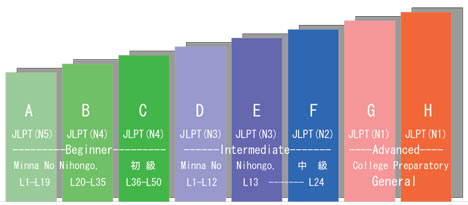
Beginner’s Classes

This program is suitable for students with no prior knowledge of Japanese. You will learn basic Japanese, both grammar and conversation, along with the writing of hiragana, katakana and kanji (roughly 350 characters). The lessons are taught entirely in Japanese and also since the textbook is written in hiragana and katakana, it is strongly recommended that you familiarize yourself with hiragana and katakana before the first lesson. Feel free to use thesehiragana and katakana study aids to help you get started. These classes will prepare you for the Japanese Language Proficiency Test, N4 or N5.
Teaching materials:Minna No Nihongo, Parts 1 & 2, Kanji workbook and other materials provided in the classroom.
Course Length: Level A-(Beginner), B-(Pre Elementary), C-(Elementary) – 9 months (3 months each)
Intermediate Classes

This course will review what you’ve learned in the beginner’s course and continue on to higher levels of grammar, reading, listening, conversation and kanji (up to roughly 1,000 characters). After completing these courses you will be ready to take the Japanese Proficiency Test, N2 or N3.
Teaching materials:Minna no Nihongo, Chukyu 1 and 2
Kanji workbook and other materials provided in the classroom.
Course Length: Level D-(Pre Intermediate), E-(Intermediate), F-(Upper Intermediate) – 9 months (3 months each)
Advanced Classes

These courses are suitable for students who have finished the intermediate program. You will learn advanced grammar (adverbs, adjectives, conjunctives), kanji (up to roughly 2,000). You will be able to read a newspaper and magazine, listen to the radio and TV during this course. When you finish the course, you will know enough Japanese to take the Japanese Proficiency Test, N1 and enter a university.
Teaching materials: Original materials such as newspaper articles, dialogues from TV dramas, etc.
Course Length: Level G-(Pre Advanced), H-(Advanced) – 6 months (3 months each)
TEST PREPARATION
Most universities require students to take the Examination for Examination for Japanese University Admission for International Students (EJU). Technical schools require students to take the Japanese Language Proficiency Test (JLPT).
The proficiency test evaluates only a student’s ability to understand Japanese language while the entrance exam covers both language skills and specific subject knowledge. Students looking to gauge their progress in Japanese often use the proficiency test as a measure.
More Information ( JLPT / EJU )
<< prev (Intensive-japanese) next (Long-term study) >> next (Short-term study) >>
- 11
12月 18
-
FREQUENTLY ASKED QUESTIONS
FREQUENTLY ASKED QUESTIONS
This page contains a lot of information on the courses and programs we offer along with a whole myriad of details, but sometimes we get questions that are specific to a given student’s situation or desires. Below we’ve listed the answers to many of these sorts of questions. If you don’t see the answer to your question please don’t hesitate to contact us.
Classes :
Q: I’ve never, ever studied Japanese at all! Can I still attend your school?
Yes, we have classes for absolute beginners but we do ask that you learn how to read and write hiragana and katakana before coming to Japan. If you practice an hour a day this should only take a couple weeks. See our hiragana and katakana pages for a description of how to read and write HIRAGANA and KATAKANA.
Depending on your nationality, you may be required to submit proof of at least 150 hours of study.
Q: I’d like to study Japanese for a year but I’m wondering if you have conversation-only classes?
Sorry, all students at Yoshida learn how to read and write while learning how to speak and listen.
How big are the classes?
The number of students in a class ranges from 10 to 18 students.
Q: What sort of qualifications do teachers at Yoshida have?
Our teachers are typically university-educated teachers with an abundance of experience, both as teachers and in other professions prior to teaching.
Q: What are the nationalities of students at Yoshida?
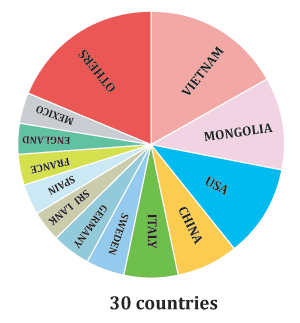
Our students come from a wide variety of countries, including Vietnam, Sweden, USA, Italy, Mongalia, Sri Lank, China, Spain, France, German, U.K., Canada, Korea, Brazil, Holland, Belgium, Australia, Maxico, Noeway, Finland, Russia, Mexico, Indonesia, Singapore, Taiwan, Thailand, Malaysia and other.
Q: Are any of your classes taught in English?
At Yoshida we use the direct method of teaching Japanese so our teachers use only Japanese in all of our classes. However, our office staff can assist you in English when you need help with something outside of school.
Q: Is the textbook available with explanations in other languages?
At the beginning level, the textbook we use has an accompanying grammar explanation written in a wide variety of languages – English, French, German, Russian, Thai, Portuguese, etc. The textbooks used in the intermediate classes likewise have a grammar explanation written in English. You’ll find links to these books on our class contents page.
Further study :
Q: What sort of test to I need to take to enter a Japanese university?
Typically you’ll need to take both the Japanese Language Proficiency Test and the International Student University Entrance Exam. You can find more information on these tests on our test preparation page.
Q: I’m interested in attending a Japanese university. Is there someone who can answer my questions?
Several times a year we have a general school meeting to explain about continuing on to a Japanese university or technical school. At the end of each quarter, students talk about their progress with their instructor at which time they have an opportunity to talk about their future plans.
If you are a beginner studying Japanese for the purpose of going on to higher education, we will not accept you for the January term, which is a short period of study.
Q: From elementary school through high school I’ve only studied for 11 years. Can I enter a Japanese university?
Technically no, but depending on the country where you studied a variety of university degrees are recognized.
Visas :
Q: Can I apply for a student visa at anytime?
The application periods are quarterly — see the long-term page for a complete description.
Q: I don’t know the meaning of a Certificate of Eligibility.
If an applicant wishes to study in Japan, he/she should in principle first obtain a Certificate of Eligibility. A Certificate of Eligibility is issued before a visa application by a regional immigration authority under the jurisdiction of the Ministry of Justice as evidence that the foreign national meets the conditions for landing in Japan, including the requirements that the activity in which the foreign national wishes to engage in Japan at the time of the landing examination is not fraudulent and is an activity that comes under a status of residence (excluding Temporary Visitor Status) stipulated in the Immigration Control Act. (Application for the Certificate of Eligibility by Yoshida Institute is allowed.)
A foreign national in possession of a Certificate of Eligibility can get a visa issued more easily at an embassy or consulate within the standard processing period (five working days from the day after the date of the acceptance of application). (However, issuance of the visa is not guaranteed.) Furthermore, by presenting the certificate at the time of the examination for the landing, the examination procedures will be smoothly carried.
Q: Who can apply for a Working Holiday Visa?
Citizens from Australia, New Zealand, Canada, the United Kingdom, France, Germany, Ireland, Norway, Denmark, Portugal, Poland, Taiwan, Slovakia, Austria, Spain, Hungary, Argentina, Chile, Iceland, Czech, Korea and Hong Kong, who are between the ages of 18 and 30 inclusive, and citizens from Australia, Canada and Korea who are between the ages of 18 and 25 inclusive, can apply for a Working Holiday Visa(except in those cases where the competent authorities of Japan agree to extend the limitation of age to 30 years). There are other conditions too, which vary from country to country. These conditions also change over time. Please contact your local Japanese Embassy or Consulate for more information.
Q: I’m Swiss and I’d like to study Japanese for six months. Do I need to apply for a student visa?
Students from England, Ireland, Switzerland, Germany, Austria, Mexico, and Lichtenstein are allowed to study in Japan for six months on a tourist visa. Upon arrival you’ll receive a 90-day visa which can be extended another 90 days during your stay in Japan.
Q: I’m Swedish and I’d like to study Japanese for two years. Do I need my guarantor to apply for a student visa?
In the case of you, the guarantor isn’t necessary. Use CSN if you are Swedish. CSN är den myndighet som administrerar det svenska studiestödet, det vill säga lån och bidrag för studier.
Q: I’m Thai and I’m wondering what are the necessary documents needed to apply for a student visa?
In addition to the documents listed on our admissions page, students from non-OECD countries need to provide documents listing the name of the person that will be supporting them financially during their time in Japan. As this varies from country to country and often depends upon current conditions, it’s best if you contact us directly for more information.
Q: I’m Russian and I’m wondering what are the necessary documents needed to apply for a student visa?
Students from Russia are required to submit not only proof of financial support. However, the Japanese government has imposed additional requirements for students from your country. You must typically submit documents verifying the status of their sponsor, typically a parent, during their time in Japan. If you’re not sure whether these requirements affect you or not, please contact us directly.
Q: Can I apply for more than one Japanese language school or apply for a Japanese language school and university at the same time?
You cannot apply for a COE to more than one school at the same time. So you need to choose the right school for you before applying.
Q: If my attendance or grades are bad what happens to my visa?
If your attendance is lower than 80% or if you’re failing your class, you won’t be able to renew your visa.
Many students maintain 90% and go on to higher education.
Q: I have a working visa. Is it possible to change to a student visa?
Yes, it’s possible. Please contact us for more details.
Q: Is there an age limit for getting a student visa?
There’s no strict limit but if you’re middle-aged or older (over 30 years old) your reason for studying Japanese and your school history will be more carefully evaluated. Please contact us for details. (Please let us know your age, nationality, educational background, and whether you have studied Japanese.)
Q: OECD countries
The OECD countries, which include countries in the EU nations, Norway, Ice Land, Poland, Hungary, South Korea, Canada, U.S.A, Mexico, Australia, New Zealand, Czech, Slovakia, Switzerland, China (Taiwan, Hong Kong), etc.
Living in Japan :
Q: Is it possible to get a commuter pass at a student rate?
This depends on the type of transportation you want to use. For subways and JR, you’ll have to pay the standard rate but bus lines (6,480 yen/m) and Tokyo Sakura Tram/Toden Arakawa Line/(5,930 yen/m) offer student passes. Other lines : Toei Subway (Asakusa Line, Mita Line, Shinjuku Line, Oedo Line) and Nippori-Toneri Liner.
If you use transportation, we recommend you buy SUICA or PASMO.

Q: Would I be able to open a bank account in Japan?

You are able to open a bank account in Japan, if you have a student visa. You need a seal (HANKO), residence card and Student ID.
More details : To open a bank account
Q: In case I return to my country, is it possible to bring my residence card as a souvenir?
If you get confirmation of embarkation without re-entry permit (including special re-entry permit) at a port of departure, you are required to return the residence card, but it will be return to the person after a hole is made in the returned residence card for invalidation.
Miscellaneous :
Q: If I bring my own computer(smartphone), can I connect to the internet at school?
Yes, you’re free to use our internet connection(WiFi) with your own computer(smartphone).
- 11
12月 18
-
INTENSIVE JAPANESE
Japanese is said by some to be a difficult language to learn, but by coming to Tokyo and immersing yourself in Japanese culture while studying every day, you’ll find that it can be a very enjoyable experience!
FULL-TIME INTENSIVE JAPANESE

Since our founding in 1986, the Yoshida Institute of Japanese Language has helped over 4,500 students learn Japanese. A friendly atmosphere among students from many different countries. We make every effort to provide our students with what they need most for their study, along with any assistance they may need to live in Japan. Some students want to learn Japanese to study further at a university or technical college, while other students study primarily for business purposes. We tailor our programs to fit these needs so that every student will be able to use Japanese successfully in the future.
Classes for all levels

Our full-time, intensive classes allow students to completely master Japanese, whether they start as a complete beginner or as an intermediate or advanced student. The school year consists of four three-month terms, during which times students practice their Japanese daily. Students in the Beginning level classes cover basic grammar need to understand daily conversations in Japanese and learn to read and write hiragana and katakana, along with a small number of Chinese characters (kanji). As students continue to the Intermediate and Advanced levels they develop the skills needed understand increasingly complex conversations and readings.
| Intensive Courses | |||||
| Term Start | January, April, July, October | ||||
| Class Schedule | Mornings : 09:00 – 12:20 or Afternoons : 13:20 – 16:40 | ||||
| Term Length | Three months (50 classes) | ||||
| Levels | Beginning(3 levels), Intermediate(3 levels), Advanced(2 levels) | ||||
We will give you
a placement test and consult with you to determine which level is best for you.
Preparation for proficiency exams
As part of their normal coursework, students at Yoshida typically prepare for one of the major proficiency examinations given in Japan. This allows students to benchmark their progress and develop sufficient language skills to enter a Japanese university, college or technical school. For most students, this means preparing for the Japanese Language Proficiency Test(JLPT), given twice a year. Other students need only take the Japanese Student Exam. Our testing preparation page describes the tests and who needs to take them.
Evaluation
- Final exam at the end of each term (every 3 months).
- To continue to the next level, a successful candidate needs a 60%(or 70%) score or higher on the final exam, 80% or better attendance.
- Upon successful completion of each course, a student progress report will be written if requested at the time of the final exam.
- (Please check the detailed information)
Academic Guidance
We offer proper guidance to students who do not have enough information about universities in Japan. In addition to 3 times per year consultations, we offer timely consultation.(Please look at Our facebook)
Yoshida’s Photo Gallery
You can’t study all the time! Our students are able to enjoy the rich environment of Tokyo and its surroundings and all that Japan has to offer. We have published many pictures of classroom (outside, extracurricular) activities on Our facebook
- 08
12月 25
-
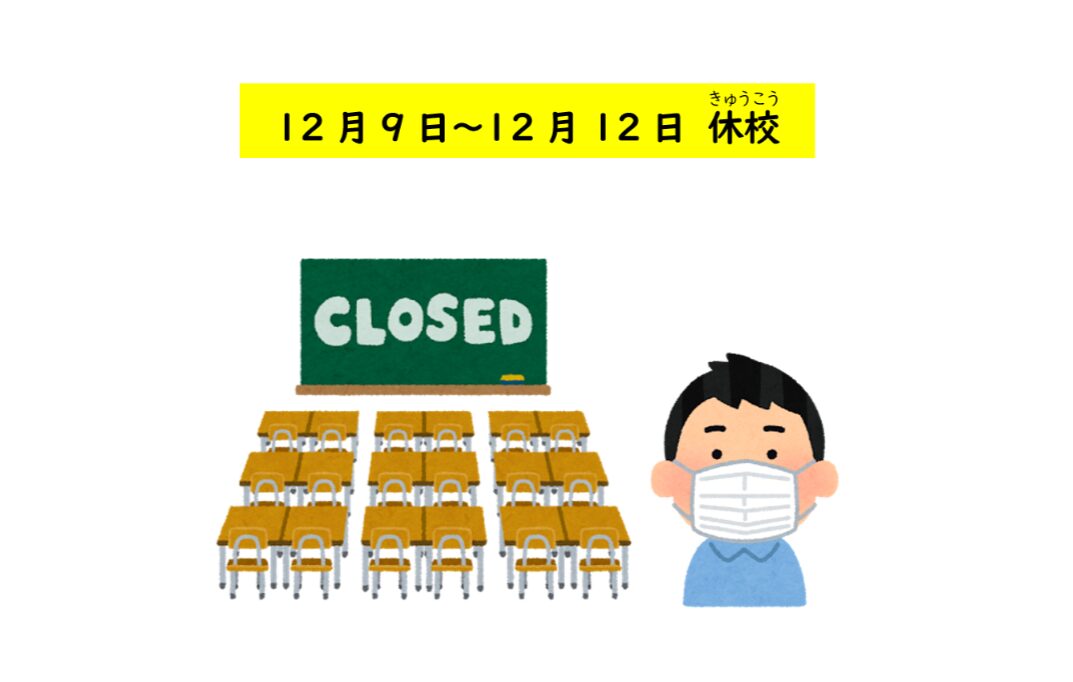
休校のお知らせ – School Closure (12/9〜12/12)
Category:NewsTo prevent the spread of influenza,
there will be no classes from December 9 (Tue) to December 12 (Fri).
Students who need assistance can visit the office between 10:00 and 16:00.
The classes will resume as usual from December 15 (Mon).
Please take care of your health.
インフルエンザの蔓延予防のため、
12月9日(火)から12月12日(金)まで授業はありません。学校にこなくても大丈夫です。
用事がある学生は、事務は10時から16時まで開いています。
授業は 12月15日(月)から普通にあります。
体調に気をつけてください。
- 21
1月 21
-
COMMUNITY NOTIFICATION
Applications for the October 2025 course have been completed.
Also, due to the school being full, we will not be accepting applications for the January 2026 term.
we are now accepting applications for consultation for the April 2026 course.
In addition, we will continue to accept consultations for those who are currently in the process of applying for the October term.
Please check the application schedule for details.
Click here for the application form.

CSN is the national authority that handle the Swedish financial aid for students.

We also warmly welcome Working Holiday program participants in Japan!

it is possible to study at this institute while visiting Japan on a 3-month temporary visa.

Students studying for longer periods usually obtain a student visa.